
No Kings: A Blueprint for Democratic Renewal
Frogs, and Dinosaurs, and Scrolls Oh My!

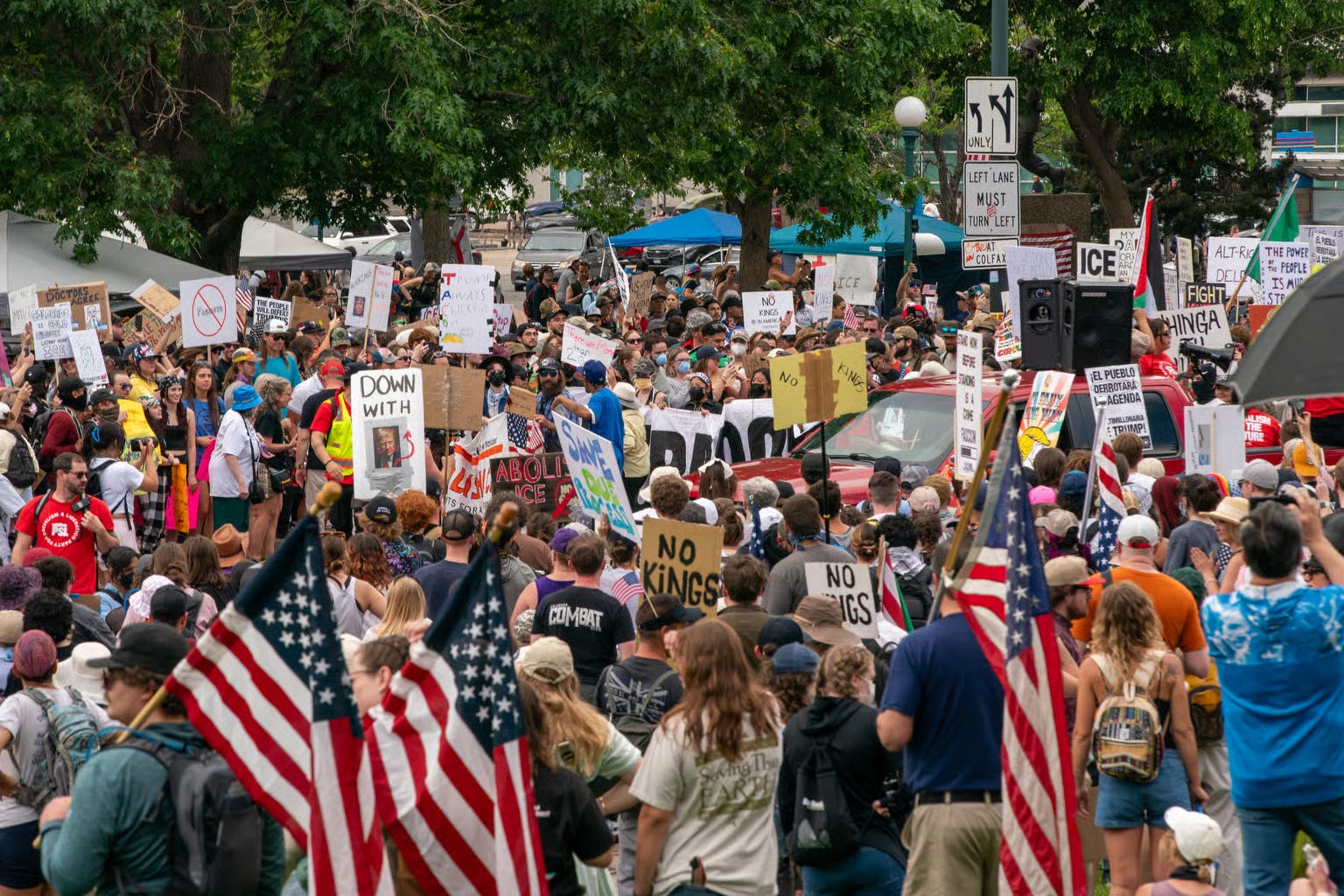
The “No Kings” movement is a reflection on our broken system, a kind of reckoning. It reflects a growing rejection of concentrated power and a demand for systemic redesign. A large number of Americans are coming to terms with the fact that the United States as they understood it is not what they have today. Whether or not it really ever reflected the civil ideals we hold is another matter, but many can agree that we are experiencing the limits of our constitutional constraints. In an environment where the vast majority are not being represented or seriously advocated for in their beliefs, they will yell it on the street. As Jon Stewart and Bernie Sanders recently discussed, this sentiment is rooted not in aesthetics or ideology, but in lived political dysfunction.
In a widely viewed interview on The Daily Show, Sanders credited Donald Trump’s electoral success to his ability to name what many Americans feel: “The system is broken.” While Trump exploits this truth, Sanders argued, Democrats must confront it head-on. “He may be a pathological liar,” Sanders said, “but he’s not stupid. The message he gives off is: ‘The system is broken and only I can fix it.’” Sanders added, “The truth is: the system is broken. He is making it worse, but the Democrats have got to acknowledge that the system is broken.”
This diagnosis resonates with the “No Kings” protests, which mobilized over 7 million Americans across 2,700 events. Protesters, many dressed in inflatable frog costumes, weren’t rallying around a party or candidate. There is a high degree of authentic spontaneity built around community organizations and locals, structured horizontally with strategic coordination. The organization, in a similar fashion to the Mamdani campaign, doesn’t need much direction. The nature of the message is such that people are willing to self-organize and mobilize without prodding. As Stewart noted, the protests were peaceful, ideologically diverse, and massive. Yet political leaders and media outlets dismissed them as “hate America rallies” or “Marxist uprisings,” revealing a deep disconnect between institutional narratives and public sentiment. It’s a call to rethink how decisions are made, who gets counted, and how power circulates.
Representation has become a bottleneck. Elected officials are expected to synthesize the will of millions, yet game theory shows that preferences in large populations are fragmented and strategically misaligned.
Expertise has become gatekeeping. Institutions reward legibility over insight, and decision-making often reflects stability rather than justice.
Governance has become performative. Citizens are spectators to policy, not participants in its design.
The “No Kings” ethos demands alternatives:
Distributed decision-making that treats citizens as co-creators, not passive recipients
Feedback systems that integrate dissent rather than suppress it
Epistemic pluralism that values contested knowledge over consensus theater
Electoral reform that reflects the intelligence of the polity—not just the preferences of the powerful
This is not utopian. It’s a response to a system that is failing to meet the moment. Legitimacy must be earned, not inherited.
We are desperate for a solution to our election system. Here is one: build a system that reflects the intelligence of the polity, not just the preferences of the powerful. That means proportional representation, open primaries, participatory budgeting, and deliberative assemblies. It means treating elections not as rituals of legitimacy, but as mechanisms for learning and deliberation.
The future of democracy will not be built by kings. It will be built by networks of people discussing where to go next. The first step is redesigning the interface between the public and power.