
Reversion to the Mean
Are Trump's tariffs responsible for the fall in trade deficits?

Today’s discussion will be considering a specific claim that Trump has made, that the implementation of his tariffs have had a remarkable effect on our trade deficit imbalance. For decades the trade imbalance has been on the forefront of public concern in relation to our financial position on the global stage. Since the fall of the Breton-Woods system, the United States has found itself for decades running substantial and indeed growing current account deficits, which have in turn fueled substantial growth throughout the world in an era of globalization. As the Trump administration steers the United States into a new order of tariffs and bilateralism, it is important that he latch onto data that have the appearance of supporting his beloved trade policy.
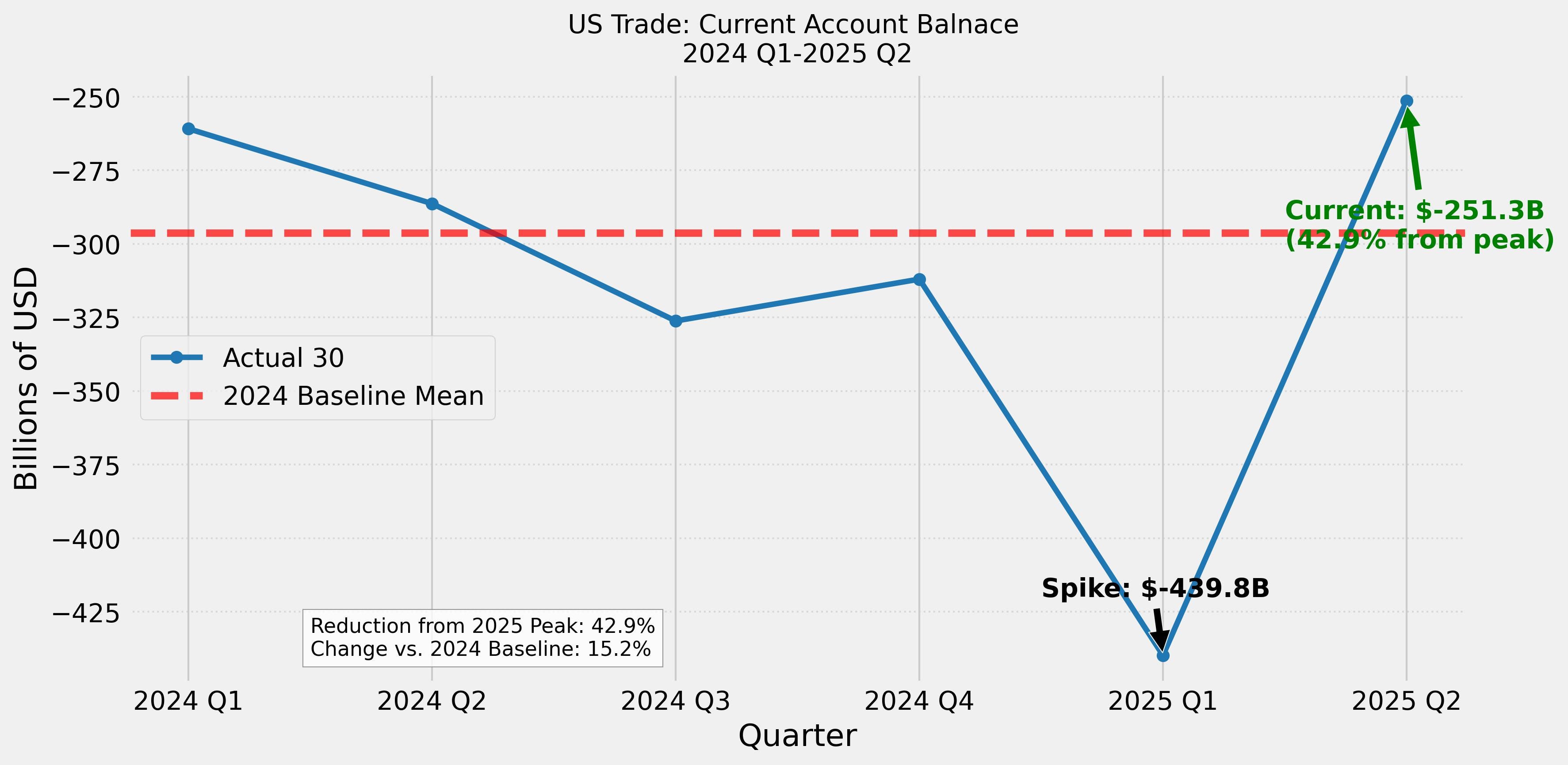
To that end, following his announcement regarding his new international drug pricing regime, while defending the state of the US economy under his administration, he made the claim that our trade deficit has been slashed by more than 50% with the onset of his tariffs. Using data from the Bureau of Economic analysis, I would like to investigate that claim’s veracity. Take a look:
Source: BEA International Data
From what we can see above, the claim that the deficit has been isolated in comparison to the period immediately before the onset of the tariffs. During that period, naturally, we saw an abnormally large spike in the deficit as anticipatory spending surged. While the current account numbers are indeed about 50 billion dollars below the 2024 mean, this represents a year over year reduction of about 17% rather than 50%. If one considers the drag on demand that the previous anticipatory surge more than likely caused, this 17% too is undoubtedly an overestimate of the effect of trump’s policy on the fall. I would argue this represents a reversion to the mean and behavioral effects more than anything.
While the administration is touting historic "deals" with Big Pharma to lower domestic prices, the broader trade deficit data does not yet show the "remarkable effect" claimed for the United States’ trade position.
I agree with your points. Thank you for sharing!